|
Thank
You for selecting the finest American Made engine available.
With simple care and common sense your engine will provide
you years of trouble free service. This product does require
mechanical ability and know-how to operate. You must be the
judge of your own ability. YOU are the person who will control
your model and engine in a safe manner and must assume all
responsibility for your activity. (Read safety
instructions.)
Take a
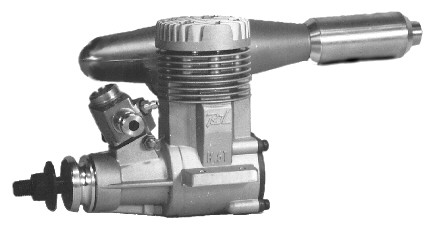
few moments to familiarize yourself with the various parts
of the engine as shown in the view below. The engine may not
have high compression until the piston ring is seated. DO
NOT DISASSEMBLE YOUR ENGINE! Doing so will void your warranty.
No exceptions!
| |
|
|
|
|
SPECIFICATIONS
|
| Bore |
.940
|
| Stroke |
.875
|
| Displacement |
10ccm - .608 ci
|
| Power
Output |
1.8 HP
|
| Weight |
18 oz w/o muffler
|
| RPM
Range |
2500-15,000
|
|
| |
|
 |
STARTING
BREAK IN |
| |
All
RJL engines are produced to the highest standards and
inspected before leaving the factory, but they are not
"BROKEN-IN" and will require approximately 90 minutes
running before the full potential of the engine is realized.
Break-in can be accomplished by airborne or bench running.
A model engine makes sounds that will tell you how it's
performing. You'll have to listen very carefully for
them, recognize their message, and make adjustments
to the fuel control needle valves accordingly. The mixture
of fuel and air is controlled by the amount of fuel
metered by the needle valve.
RICH MIXTURE running is characterized by a slower,
sometimes irregular, sputtering exhaust sound. The exhaust
gas will be smokey and probably contain small droplets
of oil. This condition is good for Break-in since the
engine receives excess lubrication and runs cooler.
FOUR CYCLING is a rich type setting, but it is
fast enough to pull the airplane. This is the setting
you normally look for before launching the airplane
because the engine will run leaner when airborne.
PEAKED
OR TWO CYCLE. As the main needle is closed (clockwise),
it reduces the amount of fuel mixed with the air drawn
into the engine. At a specific point, which varies with
each engine, air temperature, altitude and relative
humidity, the exhaust note will change quickly into
a smooth, powerful note. If the needle is closed further,
the note will stay smooth, but will weaken. The peak
occurs just at the break point from a rich setting and
further leaning will ruin the engine. A lean setting
raises the engine heat above the safe point, reduces
lubrication, and destroys glow plugs due to high combustion
temperature. This is very harmful to the engine and
your investment. Learn to tune the engine before flying.
Remember, a little rich is always preferred for long
motor life.
|
| |
|
|
STARTING
PREPARATIONS
|
| |
USE
A R/C OR IDLE BAR PLUG, 1.5 volt battery, quality propeller
(refer to prop chart below) and good commercial grade
two cycle glow fuel with 5% nitro-methane (more helps
in cold weather). Be sure the fuel contains the right
percentage of oil (17-22%) and the fuels oil contains
at least a 50-50 mix of castor oil. Not all synthetic
oil. Keep fuel clean and filter it during fueling. Keep
exposure to air to a minimum as methanol will absorb
moisture rapidly.
|
| |
|
|
FUEL
SPECIFICATIONS
|
| |
BREAK-IN
FORMULA:
22% Degummed castor oil (BAKERS AA or equivalent), or
Klotz oil, 5 to 10% nitro-methane, and the balance methanol.
AFTER BREAK-IN: The nitro-methane percentage
may be increased to 15% if desired. LOW QUALITY FUELS
CAN RUIN THE ENGINE IN A SHORT PERIOD OF TIME.
|
| |
|
|
PROPELLER
SIZES |
| |
Engine
shaft size 5/16" • Propeller: Break-in
11-7; Normal Models 11-7.5 11-7.75
|
| |
|
|
PRESSURE
LINE HOOK-UP
|
| |
Muffler
should be connected to tank.(View not available
this time) |
| |
|
|
ACTUAL
STARTING |
| |
Open
the carburetor barrel about halfway. Open the high speed
needle valve about 2 turns. Choke the engine by placing
your finger over the venturi and slowly turn the prop
over three times counter clockwise. You should see fuel
being drawn up the fuel line. If fuel is not drawn into
the carburetor, open the main needle two more turns, unscrew
the idle needle two turns and repeat the above. Connect
the 1.5 volt battery to the glow plug and pull the prop
through until you feel a bump before compression. Now
the engine will start with your chicken stick or electric
starter. Once the engine starts, open the carburetor to
full throttle. At this time the engine should be running
very rich. Slowly turn the main needle valve in and the
engine should start speeding up. If it slows, dies or
only starts with a brief bust of power and stops, the
needle valve setting is too lean. Unscrew the needle 1
more turn and try again. If engine starts, runs slowly
and briefly the mixture is too rich. Turn needle in 1/2
turn and restart. IF THE ENGINE DOES NOT FIRE AT ALL,
refer to the troubleshooting
section in this text. |
| |
- |
|
AIRBORNE
BREAK-IN (Also see "aircraft
installation" in this text.) |
| |
1>
BREAK-IN running should be done with the recommended
propeller (see chart above) at a slightly rich setting.
The needle valve should be set at a point just into
this range from a four cycle setting. Fly the plane
at maximum throttle for 2 minutes, then throttle back
for approximately 30 seconds. Repeat this sequence until
approximately 45 minutes of accumulated running time
has been obtained. Additionally, certain maneuvers,
such as "CUBAN EIGHT'S", that allow the engine to load
and unload are recommended. AVOID PROLONGED CLIMBING
MANEUVERS AT MAXIMUM THROTTLE.
2> After the first 45 minutes change to normal size
prop and fly an additional 45 minutes. Continue to run
the engine at a slightly rich four cycle setting and
fly your normal pattern.
3> After the above break-in period, run the engine
at a normal peak needle valve setting. This should be
a little on the rich side because engines run leaner
in the air. 5% - 15% nitro may be used.
|
| |
|
|
BENCH
BREAK-IN |
| |
NOTE
THAT THE ENGINE MUST BE FIRMLY MOUNTED ON A SOLID TEST
STAND. DO NOT CLAMP ENGINE IN A VISE. Muffler may be
used during bench break-in.
The initial bench break-in period is also approximately
90 minutes (40 to 45 minutes bench and 45 minutes airborne).
During this time, use the recommended break-in propeller
and run the engine at a rich setting. It is best to
run the engine for about 10 minutes, then allow it to
cool. The heating and cooling aid break-in.
1> Start the engine and run it at a rich full throttle
for about 1-1/2 minutes, then let it fast idle (about
3500 rpm's) for 30 seconds. Repeat this sequence for
about 20 minutes of running time.
2> Increase the full open throttle time to about
3 minutes followed by a 30 second idling period. Do
this for an additional for 20 minutes.
3> Install the engine in your aircraft. Using an
normal size prop, proceed as described in step 2 of
"AIRBORNE BREAK-IN".
|
| |
|
|
ADJUSTING
THE R/C CARBURETOR |
| |
RJL
engines are fitted with a variable mixture carburetor
which automatically alters both fuel and air mixtures
as it's closed. Best and most reliable carburetor settings
are obtained after engine break-in.
1> Start the engine and open the carburetor to the
full open position, then adjust for peak R.P.M. with
the main needle as previously described.
2> Close the carburetor barrel slowly until the lowest
possible speed is reached without the engine stopping.
3> Go to full throttle after about 10 seconds of
idling. If the engine gains speed slowly, the idle mixture
is too rich. If the engine stops, the idle mixture is
too lean. Turn the idle needle clockwise if mixture
is too rich and counterclockwise if too lean.
The engine will accelerate from idle to full throttle
smoothly and instantaneously when properly adjusted.
The engine may not idle well at a low setting or accelerate
as quickly until it is well broken in.
|
| |
- |
|
AIRCRAFT
INSTALLATION |
| |
These
engines are designed for beam type mounting. Securely
mount the engine an hardwood mounts or firewall mount
with a good quality motor mount. Be sure mounting surface
is flat and parallel and all mounting holes line up,
the crankcase could become distorted if screws or mounts
are forced. We strongly advise against using a soft
or rubber mount installation as our engines are correctly
balanced and these mounts can cause excess vibrations
from resonance frequencies. Do not use a back cover
mounting plate as the screw bosses are not designed
to take engine torque.
Fuel tank should be located as close to the engine as
possible. The center line of the tank should be within
1/2 inch above or below the center of the carburetor.
(View
not available this time)
Muffler pressure is recommended as it provides an even
run throughout the whole tank of fuel.
|
| |
- |
|
TROUBLESHOOTING
|
| |
Generally
most engine starting problems can be traced to bad glow
plugs, weak starting batteries, or inadequate fuel systems.
|
| |
|
|
GLOW
PLUGS
|
| |
The
glow plug when connected to a 1.5 volt battery should
glow a bright orange. If the plug slightly glows the
battery or plug should be replaced.
If the seal leaks around the center plug post, replace
it.
The glow plug element should be examined after several
flights. If the element is deformed or touching the
side of the plug body, replace it. If the glow plug
element is pitted or has a frosty look, the engine is
running too lean and continued running will seriously
harm the engine.
|
| |
|
|
FUEL
SYSTEMS
|
| |
The
most frequent problems encountered with fuel systems are:
1> Improper fuel tank location. The center line of
the carburetor should be located on the center line
of the fuel tank. See illustration.
2> Fuel pick up in tank is not free.
3> Dirt or contaminates in the fuel, tank, lines,
filter or carburetor.
4> Holes in the fuel line. The tear resistance of
silicon tubing is very low and it's not uncommon to
develop a hole where the fuel line is assembled over
the edges of brass tubing. If the engine runs well on
the first half of tank and then quits, it's almost always
caused by a hole in the pick up line inside the tank.
Look for bubbles in the fuel line, this is also a sign
of holes.
|
| |
|
|
MAINTENANCE |
| |
When
you are finished flying for the day, run your engine
dry by removing the fuel line at a moderate speed or
allow the fuel tank to run dry. It is best to squirt
some RJL AFTER RUN OIL in the carburetor, then flip
the propeller about 10 to 20 times. This oil will keep
castor based fuels from gumming and protect internal
engine parts from rust and corrosion. When storing your
model between flying sessions, it is best to wrap your
engine in a rag or plastic to prevent dust, dirt and
moisture from entering the engine. The engine should
also be wrapped in a rag at the flying field between
flights.
If dirt does enter the engine do not turn it over until
it has been flushed out completely. Alcohol is recommended
for this. DO NOT USE carburetor cleaner or chlorinated
industrial solvents as they may attack the plastic parts
of the engine. The following steps may be used as a
disassembly/assemble guide.
1> Remove carburetor, muffler and glow plug.
2>
Remove the back cover and cylinder head.
3>
Flush engine out completely using alcohol or mild solvent.
4>
Install back cover and head. Insert screws into head
and tighten until they just touch the head. Then tighten
them in the sequence shown below. Tighten the screws
only slightly, repeating the sequence a number of times
until the screws are tight.
5>
Install the glow plug and carburetor.
|
| |
|
|