|
Instruction
Manual for
BLACK STREAK SERIES
|
These
instructions should be read through carefully before attempting
to start
or run your MERCO engine. (Read
safety instructions.)
|
|
| GENERAL |
|
|
Your MERCO
engine is the product of considerable design and development
work, all aimed at making it easy to operate. The MERCO is
extremely powerful and due to exclusive design features, it
is also easy to start, flexible in fuel adjustment, and very
economical in fuel consumption. It is outstanding in its ability
to give a smooth engine run under aerobatic flying conditions
in both control-line and radio models.
The MERCO
design is the result of development over a long period of
time under actual flying conditions, motors having been flown
in national and international contests.
|
|
| RUNNING
IN |
|
.
|
Run your
MERCO engine in for at least 30 minutes on half throttle before
attempting to fly. If during the next 30 minutes of lying
time the engine slows down through overheating, slow throttle
should be used for about 30 to 60 seconds. This will cool
the engine down while in flight. It is therefore advisable
to fly fairly high for the first 30 minutes.
A straight
fuel with 25% castor oil and 75% methanol is recommended.
Do not use a fuel mix with only synthetic oil. Castor is much
better for engine life. For further details on recommended
fuels see later on in this leaflet
|
|
| STARTING |
|
|
Connect
up a leak-free tank, open the needle valve 1-3/4 complete
turns. Choke the fuel round from the tank to jet, and give
two extra chokes to get a charge of fuel into the crankcase.
Then carefully inject a small quantity of fuel through the
exhaust port onto the top of the piston. Flick the prop a
couple of times in order to get everything freed up, and connect
your battery leads, one to the top of the plug and one to
the body of the engine. Several sharp flicks should then start
the engine. Failure to start can only mean one or more of
the following faults:
(1) No
glow. Check that your battery is in a good state of charge.
Also, check your battery leads for breakages and check your
plug. You should be able to see a bright orange glow by looking
into the exhaust port with your battery leads connected and
with the piston at the bottom of its stroke.
(2) Lack
of fuel. A short sharp burst from the engine means that it
is set too lean. Open up the needle valve another 1/2 turn
and try again.
(3) Too
much fuel. A dull red glow coupled with a faint sizzling sound
from inside the engine means that the engine is too rich.
Disconnect the plug lead, close the needle valve right down
and flick the prop several times to remove the excess fuel.
When this is cleared, open up the needle valve half a turn
less than the original setting and start again.
|
|
| BATTERY |
| |
For best
results, we suggest a wet 2V accumulator, which can be recharged
when flat. |
|
| FUEL |
| |
One of
the most valuable features of the MERCO design is that for sport
practice and general flying, your MERCO engine will run without
any trouble on a straight mixture of 4 parts methanol to 1 part
castor oil. This mixture is extremely cheap to make up. It has
been found that 5% petrol does improve slow running, but this
depends to a great extent on methanol, tank position, prop,
and model. See formula below. We append a fuel table for your
guidance. Incidentally, by "castor oil", we do not
mean medicinal oil, but a good grade of oil specially developed
for use in engines, such as Castrol "M". Under no
circumstances use medicinal castor in your MERCO engine, as
it will break down under running conditions and cause your engine
to seize up. Always mix your fuel in clean containers and filter
it before use. |
|
| RECOMMENDED
FUELS |
| |
80% methanol,
20% castor oil or 75% methanol, 20% castor oil and 5% petrol. |
|
| GLOW
PLUGS |
| |
Long reach
1/4" plugs should be used. MERCO engines have been run
on all types of pugs and respond well to any of them. |
|
| PROPELLERS |
| |
As required
for model. |
|
| ADJUSTING
THROTTLE |
| |
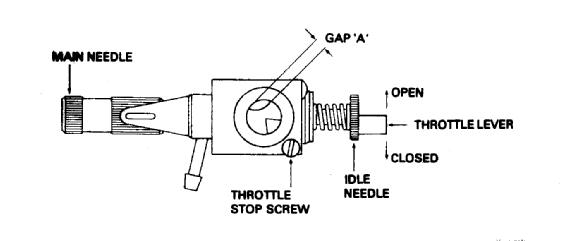
Before
attempting to adjust the throttle for idle, set controls as
follows:
(1) Holding
throttle lever in open position, screw in idle needle until
resistance is felt, then unscrew idle needle 4 complete turns.
(2) Now
holding throttle lever in closed position, adjust throttle
stop screw until gap A is approximately 3/64".
(3) Open
main needle 2-1/2 complete turns and start the engine, let
the engine attain running temperature and tune for peak RPM
with main needle as usual.
(4) Close
throttle and allow engine to idle for a few seconds, open
throttle and if engine picks up slowly with excess smoke screw
in idle needle. If engine cuts, unscrew idle needle.
(5) Now
adjust throttle stop screw for slow idle, finally re-adjust
idle needle if necessary. The settings may have to be altered
after break in period.
(6) If
settings are lost it is advisable to go back to step no. 1.
|
|
|
|
|
| MARINE
UNITS |
|
|
All the
above instructions apply to marine units with the addition
of the following:
Do not
run your engine flat out without load.
Do not run your engine without water flowing through the water
jacket.
Failure
to observe these two rules will result in expensive damage.
Use prop
recommended for your boat.
|
|
| SERVICING |
|
|
All engines
should be returned direct to the makers for repair. When returning
your engine, please state briefly the nature of the repair
required. An estimate of the cost of repair will be sent to
you before any work is undertaken.
Minor
repairs will be carried out for a nominal service charge plus
the cost of all necessary spare parts and postage and packing.
|
|
CARE
OF YOUR ENGINE
MOUNTING THE ENGINE AND FUEL SYSTEM |
|
| |
Engine
Bearers: The nose and engine bearers should be built as
rigidly as possible to eliminate vibration. |
|
| |
Fuel
Tank Position: Ideally, the centre line of the fuel tank
should correspond with that of the needle jet. If this cannot
be achieved with an upright engine, side mounting may be necessary. |
|
| RUNNING
THE ENGINE |
|
|
Once all
throttle settings are established, the following procedure
for starting is suggested. Open throttle, choke with finger
and flick prop 3 or 4 times, shut throttle to within 1/16"
of fully closed, connect glow lead, flick prop until engine
starts. As engine warms up, open throttle ready for takeoff.
If you
find that your engine is running "rich" on takeoff
and then tending to cut out in the air, fit new plugs. The
platinum element in the plug oxidises with use and then loses
efficiency when it is not connected to the battery.
|
|
| SERVICING
THE ENGINE |
|
|
Before
attempting to take your engine apart, please read Part 1 of
your guarantee.
Do not
dismantle your engine unless absolutely necessary. However,
if you feel that it is essential:
1. On
no account disturb the crankshaft and bearings in the crankcase;
2. Do not spin crankshaft unless it is (a) clean and (b) lubricated;
3. Wash all parts in clean methanol;
4. Lightly oil all moving parts with 3 in 1;
5. When reassembling, use the cross system to tigthen the
head-screws. It is imperative that when tightening these screws
each screw should exert the same pressure on the head at any
one time - if one screw causes more stress to the head than
others, your engined could be damaged.
|
|
|
NOTES
ON MERCO ABC ENGINES
|
|
|
The operating
and care procedures that apply to MERCO engines with piston
rings also apply to MERCO ABC engines but the running in methods
differ. The chrome-plated brass liner in an ABC engine is
minutely tapered at the top end but the hardened steel liner
in a "ringed" engine is perfectly parallel. An ABC
engine does not have a piston ring; the cast aluminum piston
fits perfectly inside the liner to create the compression
seal and when new, the taper causes the piston to feel tight
as it nears top-dead-centre. A "ringed" engine will
not exhibit such tightness. A piston ring is fitted into a
piston ring groove and the piston fits loosely into the steel
liner. The sprung piston ring expands against the liner to
create the compression seal. Both types of engine prefer castor
fuel mixture.
It is
much easier to run in an engine on a test-bench before installation
into a model. Running in a "ringed" engine is described
in the instruction manual. An ABC engine requires longer to
run in but the extra time is well worth while; a carefully
run in engine will last longer and develop much more power.
Start the engine in the usual manner by hand or starter motor
and run on a rich mixture at about half speed for ten minutes
then allow to cool. If the engine slows down due to overheating
at any time, stop, allow to cool, and start again. Repeat
the minute run-and-cool procedure at least four more times
progressively leaning out the mixture and speeding up the
engine on each occasion until peak RPM can be achieved and
maintained.
|
|
