|
WE CAN'T STRESS
THIS ENOUGH! Unlike poppet valve four strokes the HP VT's
and WEBRA 4 Stoke engines have a rotary valve which requires
an oil film to seal properly. A minimum of 20% content, 22%
is best. Caster oil is the preferred best, a 50/50 castor/synthetic
only if 22% or more oil. More then 50% castor is better. If
the oil content is too low the engine will not draw fuel well
and idle properly This is due to leakage back into the intake
manifold disrupting the incoming fuel/air mixture.
You also risk insufficient oil in the crankcase and cause
premature wear on the crank pin, connection rod bearing, and
piston. Not to mention excessive wear on the valve and gear
train on all the VT's. There's no gears in the WEBRA 40, 60
& 80, just the WEBRA 90 has a gear train in the head.
|
The only
oil available to these components is from blowby from
the piston and valve or from the exhaust gases. The
is the reason for a good percentage of Castor oil. Unlike
synthetic, Castor oil does not burn as readily as synthetic,
so the muffler pressure nipple supplies the unburned
Castor to the components mentioned above.
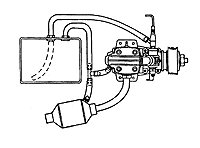
On the VT
the pressure nipple must be connected to the head and
the nipple on the lower crankcase must be an open vent.
There is a passage through the gear tower shaft. For
muffler pressure a tee fitting between the muffler and
head may be used. DO NOT try using the nipple on the
lower crankcase, it must vent to open air.
|
 |
Use a
good quality fuel with the formula printed on the label. See
also Fuels
|
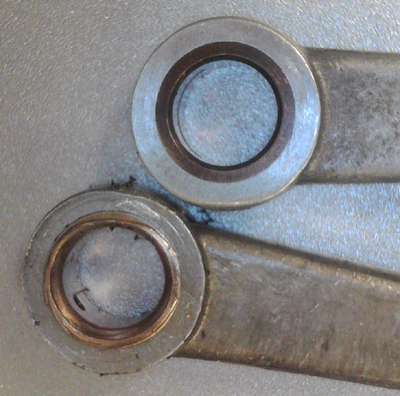 |
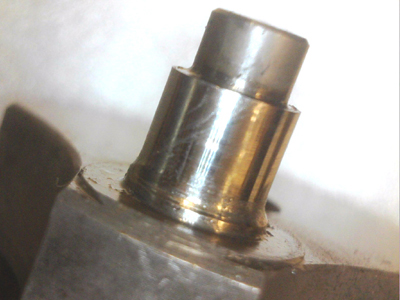
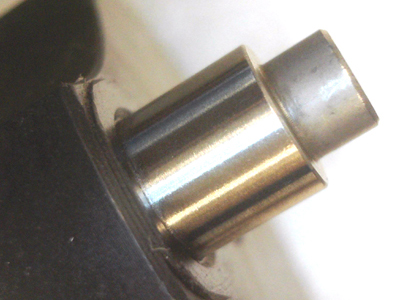
The hardened steel
crank pin wore down from a .232" diameter on the right
to .205" diameter on the left.
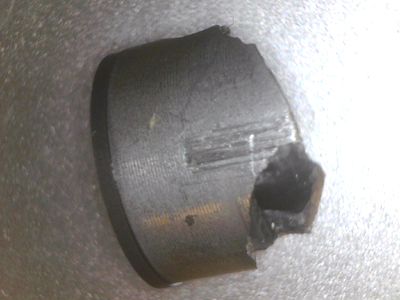
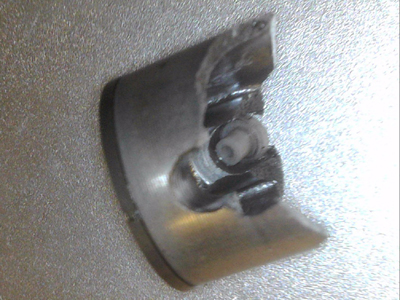
The additional
slop caused the rod to twist and break the piston which has
score marks and confirms lack of oil resulting in the failure
of the piston.
Just a note for reference: Breaking in an engine by spinning
the crankshaft while submerged in a hot oil bath or just spinning
the crank with a drill press is the absolute worst practice.
All the components are working in the wrong wear/stress direction
so resulting wear patterns are detrimental to engine life.
|
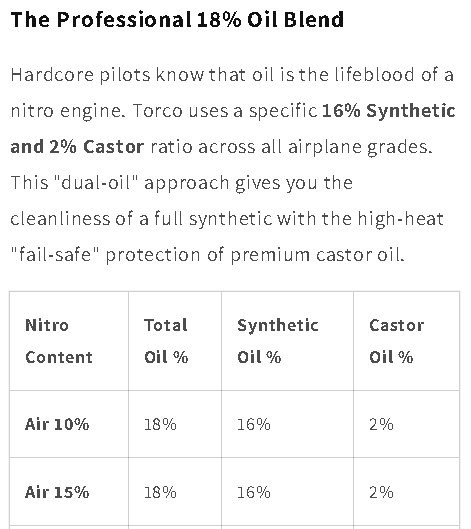 |
This is the fuel
used in the above with the customer adding 6 ounces of Klotz
castor to a gallon. Please note Torco makes good fuel, just
this blend is not good for rotary valve four strokes.
You would have
had to add 12 oz of caster oil to the Torco fuel to meet our
minimum of 14 oz required per gallon.
|
Just a reminder:
The K&B 7311 works perfect in HP VT four stroke
engines. Don't use an R/C, 4 cycle, miracle or any other
plugs that have anything extending from the end. These
plugs can hit and destroy the rotary valve. Note: Early
VT 21's use a standard short plug like the K&B 1S
7321. Look into any port on the head and you can identify
the early version by the rotating valve, early used
a bronze valve in a chromed sleeve, all later engines
used a chrome valve in a bronze sleeve.
|
|