|
The
Basics - 2 Stroke Principal
|
| A
two stroke engine must transfer the fuel charge from the crankcase
into the cylinder. As the piston moves downward and the intake
port on the crankshaft closes (see
crankshaft rotation) the fuel charge is compressed. This
fuel charge must be directed into the cylinder and accomplish
several things. The attempt is to have the have the cleanest
fuel/air charge for the next combustion. The remaining exhaust
gases from the previous combustion must be pushed out the exhaust
port by the incoming fuel/air charge. A clean sweep of the entire
cylinder volume is attempted without any of this new fuel charge
to escaping out the exhaust port. Port timing and direction
are used to accomplish this. |
|
ALL
THE DIFFERENT PORTING
|
|
Schnuerle
Porting and the boost port
|
|
|
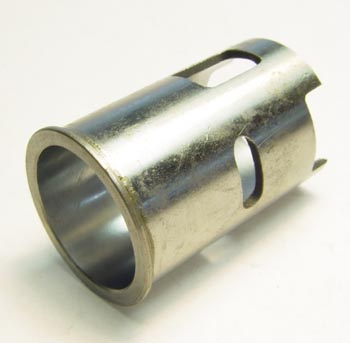
Named for its inventor,
Dr. Schnuerle, these ports are two angled ports that focus the
incoming fuel charge towards the back of the cylinder. A Schnuerle
ported engine only has to have the two ports to be considered
Schnuerle Ported. The boost port, the single angled upward
third port, is not a Schnuerle port. It is an additional port
to force the fuel charge upward into the cylinder.
|
|
|
Loop
Scavenged. This the the original 2 stroke porting.
|
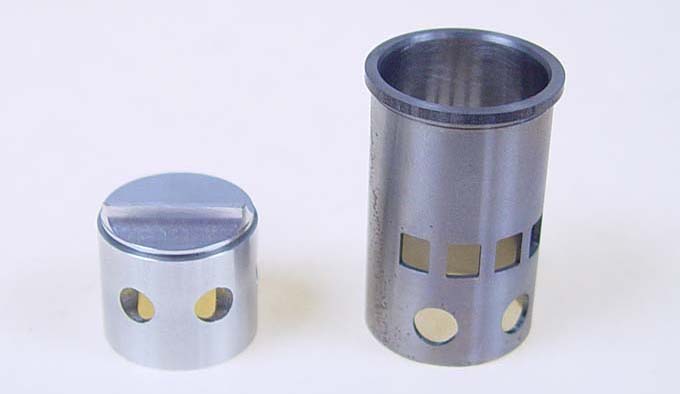
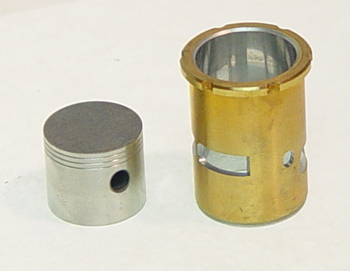
This example has holes in the lower part of the sleeve and
piston. We refer to them as "cheater holes". They
allow more air/fuel charge to pass through the piston skirt
into the transfer channel and also cool the inside of the
piston.
|
Fuel/air charge
comes in on one side, hits the baffle and loops up to the
combustion chamber then out the exhaust ports.
All loop scavenged
engines have a baffle on top of the piston. Some refer to
this as cross scavenged.
|
|
|
PDP
- Perry Directional Ports
|
|
|
Perry ports are
two tiny ports positioned on the exhaust side of the piston
baffle. These ports direct a small charge of fuel/air to clear
a small dead zone of exhaust gas. All Perry ported engines have
a piston with a baffle on top. |
|
|
Hybrid
Modified Loop scavenged Schnuerle ports
|
|
|
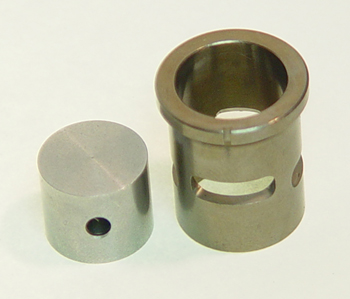
Some engines use
a flat top piston with a large boost port and small ports
similar to Schnuerle type ports to direct the fuel charge
back away from the exhaust port as the boost port is angled
up to clear the cylinder post combustion gases.
Side note: The
small grooves near the top of the piston are oil retention
grooves. ABC engines have a tight fit so the oil film is easily
wiped away with each stroke.
|